 By Carol Egan, M.Ed., CHHC, CNC
Environmental Health Researcher
We know that the body needs nutrients to function. We test for deficiencies, evaluate symptoms, investigate abnormal laboratory findings and provide treatments intended to restore health.
But what happens when environmental toxicants are interfering with the very physiological functions we are trying to support?
This is a question I believe deserves far greater consideration.
Research shows that pesticides, plastics, heavy metals and biological toxins can disrupt mitochondrial energy production, intestinal defenses, microbial metabolism and cellular signaling.
These are the same functions involved in many of the conditions practitioners evaluate every day.
Yet environmental exposures are not always included in the clinical assessment.
Foundational Medicine begins by considering not only what the body needs, but what may be interfering with its ability to function.
For me, the principle is simple: Remove what doesn’t belong. Add what does.
Three Perspectives, One Patient
Imagine a house is on fire.
We must first protect the people inside, contain the fire and prevent further damage. Then we can assess what needs to be repaired.
The same principle can help us understand the importance of identifying ongoing sources of physiological injury.
Traditional medicine provides essential tools for diagnosing and treating disease. Functional medicine often expands the investigation into nutrition, metabolism and relationships between physiological functions.
Foundational Medicine places emphasis on environmental toxicants, biological toxins, pathogens and their effects on cellular function.
These perspectives need not compete. They can complement one another.
Consider a patient with persistent fatigue. A practitioner may appropriately investigate thyroid function, anemia, sleep disorders, nutritional deficiencies and other potential causes.
I would want those findings, too. But I would also want to know whether relevant environmental exposures might be influencing mitochondrial function.
Why?
Because research demonstrates that environmental toxicants can interfere with the biochemical machinery responsible for producing cellular energy. [1]
Correcting a deficiency may be necessary, but it does not necessarily address a toxicant that is interfering with the process the nutrient supports.
When Toxicants Interfere With Cellular Function
Our cells depend on a continuous exchange of electrons to produce energy, maintain antioxidant defenses and metabolize substances.
These oxidation-reduction, or redox, reactions are fundamental to life.
Mitochondria use electron transfer to produce adenosine triphosphate (ATP), the molecule that supplies energy for cellular activity.
The liver uses electron-dependent enzymes, including the cytochrome P450 family, to metabolize medications, hormones and environmental chemicals.
Glutathione participates in cellular antioxidant defenses and is continually recycled through enzyme reactions.
These processes require nutrients and functional enzymes.
But environmental toxicants can interfere with them.
A 2024 scientific review describes how environmental chemicals can disrupt mitochondrial respiration, damage mitochondrial membranes, increase oxidative stress and alter mitochondrial DNA and cellular signaling. [1]
These effects matter because mitochondria support far more than energy production.
They participate in calcium regulation, immune responses, programmed cell death and steroid hormone synthesis.
The kidneys depend heavily on mitochondrial energy for transport functions. Intestinal cells require it to maintain their protective barrier. Neurons need it for signaling, and immune cells adjust mitochondrial metabolism during inflammation and infection.
A toxicant that interferes with mitochondrial function can therefore affect biological processes shared by several organs.
This is one reason environmental exposure history can be relevant when clinical findings involve more than one physiological function.
When the Intestinal Terrain Is Affected
One of the most compelling examples comes from research on bisphenol A (BPA), a chemical used in certain plastics and food-contact materials.
BPA is widely studied for its endocrine-disrupting properties.
But researchers have also demonstrated effects on intestinal mitochondria.
In a 2019 laboratory study using human intestinal goblet cells, BPA disrupted mitochondrial function, reduced ATP production, increased oxidative stress and impaired secretion of mucin 2, an important component of the intestinal mucus barrier. [2]
Consider the connections.
BPA exposure → mitochondrial dysfunction → reduced ATP and increased oxidative stress → impaired protective mucus secretion.
The intestinal mucus barrier helps protect the epithelial cells lining the bowel from contact with intestinal contents, including microorganisms and their products.
A disturbance affecting mucus production can therefore influence an important part of intestinal defense.
And environmental chemicals can affect the microorganisms themselves.
In 2025, researchers examined interactions between pesticides and representative species of human gut bacteria. Their analysis included 306 pesticide–bacteria combinations.
They found that pesticides could inhibit or promote bacterial growth and alter microbial metabolism. The investigators also identified changes involving hundreds of microbial metabolites.
In a mouse model, pesticide-related disruption of microbial lipid metabolism contributed to intestinal inflammation. [3]
These studies demonstrate two relationships that deserve to be considered together.
Environmental chemicals can interfere with the intestinal cells responsible for maintaining the protective barrier. They can also influence the metabolism and behavior of microorganisms living within the bowel.
For a practitioner investigating persistent gastrointestinal complaints, this expands the physiological questions worth asking.
What is happening to the intestinal barrier? What is influencing microbial activity? Could relevant chemical exposures be affecting either process?
The laboratory findings do not establish the cause of an individual patient’s symptoms. But they identify mechanisms that can inform the investigation.
A microbial test tells us which organisms were detected. It does not tell us everything about the environment influencing their activity.
That is an important distinction in Foundational Medicine.
When Toxicants and Parasites Interact
Parasites provide another interesting example of the relationship between organisms and their environment.
Environmental researchers have demonstrated that some intestinal parasites of fish can accumulate substantial concentrations of metals.
In one study, investigators collected the parasite Pomphorhynchus laevis from ten fish in Germany’s River Ruhr.
The concentration of lead in the parasites was approximately 2,700 times higher than in the muscle tissue of their fish hosts. [4]
Researchers identified these parasites as potentially useful indicators of environmental metal contamination.
This finding demonstrates that organisms can accumulate environmental contaminants in ways that differ substantially from their hosts.
It does not establish that human parasitic infections arise because of toxic exposure, or that parasites routinely protect people by absorbing toxicants.
But it does reinforce a broader important biological principle: organisms, their hosts and their chemical environments interact.
This relationship is worth understanding when investigating parasitic infections and environmental exposures, while recognizing that each requires its own appropriate assessment.
When Several Findings Share a Cellular Connection
Consider a patient presenting with fatigue, gastrointestinal symptoms, altered hormone findings and signs of inflammation.
Each finding deserves investigation.
But the physiological functions involved are interconnected.
Intestinal cells depend on mitochondrial energy to maintain their protective barrier. Immune cells use mitochondrial metabolism to regulate inflammatory responses. Steroid hormone production begins with the conversion of cholesterol into pregnenolone inside mitochondria.
Environmental toxicants can affect several of these processes, although the mechanisms differ by chemical and tissue.
This is not evidence that one toxicant caused every symptom. It is a reason to consider whether a relevant exposure could be contributing to more than one finding.
Robert Naviaux, MD, PhD, offers another perspective through his research on the cell danger response.
Naviaux describes how cells change their metabolism and signaling when exposed to biological, chemical or physical stress. Mitochondria participate in coordinating defensive responses and the processes involved in recovery. [5]
His model proposes that persistent disturbances in these responses can contribute to ongoing physiological dysfunction.
The important distinction is that reduced cellular energy can reflect direct injury, altered metabolic regulation or a combination of processes.
Understanding what is affecting the cell becomes part of understanding what may be affecting the patient.
The examples in the table below illustrate different areas of emphasis, not exclusive approaches. Practitioners from any discipline may investigate several of these factors.
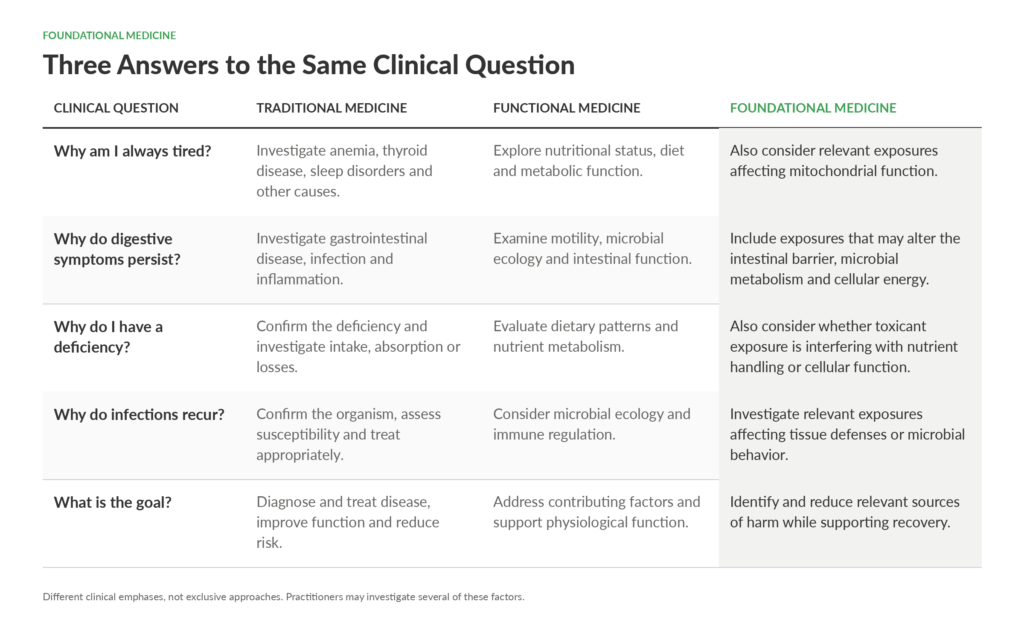
The distinction is not that one approach addresses root causes and the others do not.
Rather, it is the particular attention Foundational Medicine gives to environmental exposures and their effects on the same biochemical processes already being evaluated clinically.
Removal Comes First: What This Means in Practice
Environmental toxicants, toxins and pathogens require different approaches to assessment and intervention.
The first priority is to identify what is relevant to the individual patient.
A comprehensive clinical evaluation can include environmental exposure history alongside symptoms, laboratory findings and established diagnoses.
Occupational exposures, drinking water, food sources, pesticides, metals and other environmental influences may help identify which further investigations are appropriate.
When a harmful exposure is identified, reducing or eliminating its source becomes an important part of care.
But reducing ongoing exposure is not necessarily the same as removing a substance already absorbed into the body. Treatment depends on the specific chemical, its behavior in the body and the patient’s clinical condition.
The same principle applies to infections. A clinically significant pathogen requires appropriate assessment and treatment. Environmental exposures may also be relevant, but they do not replace the need to address a confirmed infection.
Supporting normal physiological function remains essential throughout.
Nutrition, mitochondrial metabolism, bowel elimination, liver function and kidney function all contribute to the body’s capacity to maintain internal balance.
This is why the Foundational Medicine approach I advocate is not simply about detoxification.
It is about identifying what is contributing to dysfunction, reducing harmful exposures wherever possible, addressing clinically relevant infections and supporting the physiological functions required for recovery.
And then reassessing what has changed.
A Broader Understanding of What Causes Dysfunction
I believe we need to consider environmental toxicants and biological toxins when assessing patient symptoms, laboratory findings and test results.
The research demonstrates that these exposures can interfere with mitochondrial metabolism, intestinal defenses, microbial activity and cellular signaling.
These are not peripheral biological processes. They influence the functions of organs and tissues throughout the body.
For practitioners, understanding these relationships offers another way to interpret complex findings and investigate what may be contributing to persistent dysfunction.
It also helps explain why supplying nutrients or supporting an organ may not be sufficient when a relevant source of injury remains unaddressed.
I bring this connecting-the-dots Foundational Medicine philosophy into my environmental health research and educational partnerships.
My goal is to bring to life the deeper science researchers devote their careers to, and show how their findings relate to what practitioners see in the clinic every day.
Remove what doesn’t belong. Add what does.
The more clearly we understand what is affecting the body’s ability to function, the better we can determine what it needs to recover.
Research References
[1] Zuo M, et al. Mitochondrial Dysfunction in Environmental Toxicology: Mechanisms, Impacts, and Health Implications. Chemical Research in Toxicology. 2024;37:1794–1806. https://pubmed.ncbi.nlm.nih.gov/39485318/
[2] Zhao Z, et al. Bisphenol A inhibits mucin 2 secretion in intestinal goblet cells through mitochondrial dysfunction and oxidative stress. Biomedicine & Pharmacotherapy. 2019;111:901–908. https://pubmed.ncbi.nlm.nih.gov/30841469/
[3] Mapping pesticide-induced metabolic alterations in human gut bacteria. Nature Communications. 2025;16:4355. https://doi.org/10.1038/s41467-025-59747-6
[4] Sures B, Taraschewski H, Jackwerth E. Lead accumulation in Pomphorhynchus laevis and its host. Journal of Parasitology. 1994;80:355–357. https://pubmed.ncbi.nlm.nih.gov/8195935/
[5] Naviaux RK. Metabolic features and regulation of the healing cycle: A new model for chronic disease pathogenesis and treatment. Mitochondrion. 2019;46:278–297. https://pubmed.ncbi.nlm.nih.gov/30099222/





Leave a Reply